Stairs can become one of the biggest obstacles to aging in place. A parent may still cook, manage conversations, and enjoy living independently but find climbing to the bedroom or descending to the laundry room increasingly difficult.
That does not automatically mean the person must move.
Burlington families considering alternatives can explore senior home care services from Maple Senior Home Care for aging-in-place assistance, personal care, meals, homemaking, and everyday mobility support. The best solution depends on why stairs have become difficult and whether essential daily activities can be arranged safely.
Why Do Stairs Become Difficult for Seniors?
Climbing stairs requires strength, balance, coordination, vision, and cardiovascular endurance.
Arthritis may make bending the knees painful.
Reduced muscle strength can make each step harder.
Parkinson’s disease, stroke, neuropathy, poor vision, and other conditions may affect balance or foot placement.
Some seniors can use stairs once but become exhausted when making repeated trips.
Others manage climbing but feel unstable while descending.
Understanding the exact difficulty matters.
Maple Senior Home Care can assess everyday support needs, while a physiotherapist, occupational therapist, or other appropriate clinician may be needed to evaluate mobility and recommend safe techniques or equipment.
Count How Often Your Parent Actually Uses the Stairs
Families sometimes focus on whether a parent can physically climb the stairs once.
A more useful question is how often they must do it.
If the bedroom is upstairs, kitchen on the main floor, and laundry in the basement, the person may need multiple trips each day.
Bathroom location also matters.
A parent who can carefully climb the stairs in the morning may not be able to safely repeat the trip when tired at night.
Maple Senior Home Care can help families think through daily routines during a nurse-led assessment.
The care plan should consider where activities occur inside the home rather than treating mobility as a general issue.
Can the Home Be Reorganized Around One Floor?
In some homes, moving essential activities to one level can reduce unnecessary stair use.
This may involve creating an appropriate sleeping area on the main floor or relocating frequently used household items.
However, the arrangement must be practical and safe.
Consider bathroom access, privacy, emergency exits, ventilation, and whether the senior can move safely through the new space.
Do not simply place a bed in a crowded living room and assume the problem is solved.
An occupational therapist can help assess whether a one-floor arrangement is suitable.
Maple Senior Home Care can then organize personal support, meals, and homemaking around the accessible living area.
What Home Modifications May Help?
Possible modifications depend on the individual and property.
Proper railings, adequate lighting, and clear stairways are basic considerations.
Some families investigate stair lifts or other accessibility equipment.
These products should be selected only after considering whether the senior can safely transfer onto, operate, and exit the equipment.
Professional installation is also important.
Maple Senior Home Care does not replace qualified accessibility assessment or installation professionals.
Its role is to provide appropriate daily assistance around the senior’s assessed home environment.
Families should be cautious about buying expensive equipment before understanding the parent’s mobility limitations.
Can a Caregiver Help a Senior Use Stairs?
A caregiver may provide mobility assistance according to the person’s assessed needs and approved care plan.
However, simply placing another person beside an unsafe staircase does not automatically make stair use safe.
The senior may need a specific technique, equipment, or a different household arrangement.
Caregivers should follow mobility instructions from appropriate rehabilitation professionals.
Maple Senior Home Care can incorporate those instructions into the personalized care plan.
If a senior’s ability changes, the transfer or mobility approach should be reassessed rather than improvised.
The caregiver’s presence is valuable when suitable assistance has been identified, but it is not a substitute for correcting an unsafe environment.
How Can Home Care Reduce Unnecessary Stair Trips?
A caregiver can perform tasks that otherwise require the senior to repeatedly move between floors.
Laundry is a common example.
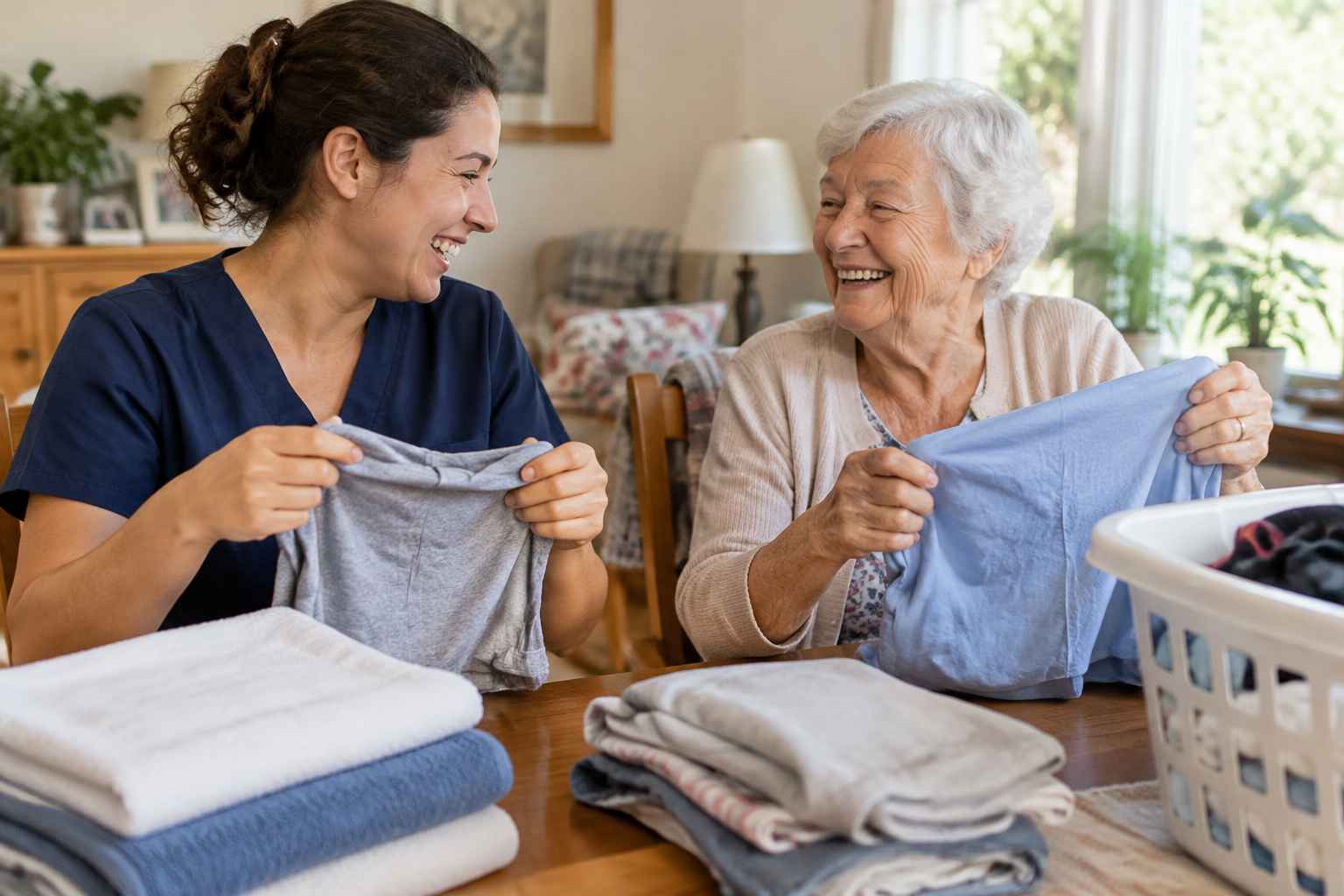
If the washing machine is in the basement, Maple Senior Home Care homemaking assistance may eliminate the need for the parent to carry laundry downstairs.
Meal preparation can reduce repeated kitchen trips when fatigue is an issue.
A caregiver may also bring required household items to the accessible living area.
Personal-care visits can be scheduled around bathing or dressing routines.
This is where aging-in-place support becomes broader than mobility assistance.
The goal is to redesign the daily routine so the parent does not repeatedly confront avoidable physical barriers.
What About Nighttime Bathroom Access?
Nighttime mobility deserves particular attention.
A senior may manage stairs during daylight but struggle when sleepy or when lighting is reduced.
If the only bathroom is on another floor, families should discuss realistic alternatives with appropriate professionals.
Do not rely on the instruction to “be careful.”
If the person cannot safely reach essential facilities, the living arrangement needs to change.
Maple Senior Home Care can provide overnight or extended assistance when appropriate, but staffing alone may not solve a fundamentally inaccessible home layout.
The care assessment should consider what happens between scheduled visits as well as while the caregiver is present.
When Does Stair Difficulty Mean a Move Is Necessary?
There is no universal threshold.
Some seniors remain at home successfully after appropriate modifications and support.
For others, the house eventually becomes impractical despite substantial assistance.
Consider whether essential activities can be performed safely, whether the parent can access emergency exits, how much supervision is required, and whether the care arrangement remains sustainable.
Maple Senior Home Care supports aging in place but should not be viewed as evidence that every home can remain suitable indefinitely.
The parent’s safety, preferences, finances, health, and household design all matter.
A move should not be treated as failure, just as staying home should not be treated as the only successful outcome.
How Often Should the Home Plan Be Reassessed?
Mobility changes.
A plan that worked six months ago may become unsuitable after a fall, hospitalization, surgery, or progression of a chronic condition.
Reassess when the senior begins avoiding certain rooms, reports increased fear, or needs substantially more assistance.
Maple Senior Home Care can adjust caregiving hours and services as daily needs change.
Families should also request updated rehabilitation or accessibility advice when the physical problem changes.
Aging in place works best as an ongoing process rather than a one-time decision.
Frequently Asked Questions
Does difficulty climbing stairs mean a senior must move?
Not necessarily. The feasibility of remaining at home depends on the person’s mobility, home layout, available modifications, and support.
Can a caregiver carry a senior up the stairs?
Unsafe manual lifting should not be improvised. Mobility and transfer methods require appropriate assessment and training.
Can home care help if laundry is in the basement?
Homemaking assistance can reduce the need for the senior to complete physically demanding household tasks such as laundry.
Is a stair lift always the best solution?
No. Suitability depends on the person’s transfers, cognition, balance, home layout, and other factors.
Arrange Aging-in-Place Support in Burlington
Difficulty with stairs should prompt a practical review of how the entire home functions.
Sometimes reducing unnecessary trips, modifying the environment, and adding targeted assistance can allow an older adult to remain at home safely.
Maple Senior Home Care provides aging-in-place support, PSW personal care, meal preparation, homemaking, companionship, and extended home care in Burlington.
Maple Senior Home Care also serves Oakville, Milton, Mississauga, Brampton, Vaughan, Markham, Richmond Hill, and Toronto.
To discuss your parent’s home environment or arrange a free in-home nurse assessment, call Maple Senior Home Care at (437) 370-3710.